Anthropocene Sensors

Project
Anthropocene Sensors
Industry
Speculative Design / Design Research / Design Fiction / Interaction Design
Institution
Goldsmiths, University of London
Services
  • Design research
  • Speculative design
  • Design fiction
  • Narrative design
  • Interaction design
  • Video production
  • Editorial design
Design Team
  • Benjamin Jeffries
  • Aaron Yuxuan Zhao
  • Sara Khorsandi
  • Piero Santoloci
  • Theodora Beck
Advisors
  • Alex Wilkie
  • Andy Boucher
  • Liam Healy

Using design fiction to explore how environmental sensing technologies could shape everyday life in an increasingly monitored world.

Context

Anthropocene Sensors was a collaborative design research project completed as part of the MA Design: Expanded Practice at Goldsmiths, University of London.

The project explored the growing role of environmental sensing technologies in everyday life, examining how systems that monitor air quality, energy consumption, and climate are becoming increasingly embedded within domestic environments. Rather than viewing these technologies as purely technical tools, the project investigated their social, cultural, and emotional impact through speculative design.

Challenge

Environmental sensing systems often operate invisibly, collecting data that influences behaviour without users fully understanding how the systems function.

The challenge was communicating these complex technologies in a way that felt accessible and engaging. Rather than producing a traditional research project, we explored how storytelling could encourage people to reflect on their relationship with intelligent environmental systems.

Our Approach

Creating a Fictional World

The project was set within a fictional Season 11 of the television series Friends, imagining how the characters might navigate climate change, smart homes, remote working, and environmental sensing technologies.

Using a familiar cultural setting allowed complex technological ideas to become approachable through humour and everyday situations.

Designing Speculative Products

We developed a collection of conceptual sensing devices that existed within this fictional world. Each product explored a different relationship between people, technology, and environmental data, encouraging discussion rather than proposing commercial solutions.

Building the Narrative

To communicate the project, we produced a complete speculative ecosystem including a pilot episode script, storyboard, physical props, a video trailer, and a live table-read performance. These outputs allowed audiences to experience the research through narrative rather than explanation.

Research Through Design

The project combined methods from speculative design, Science and Technology Studies, and participatory research. Design became the vehicle for exploring broader questions around environmental responsibility, automation, and human agency.
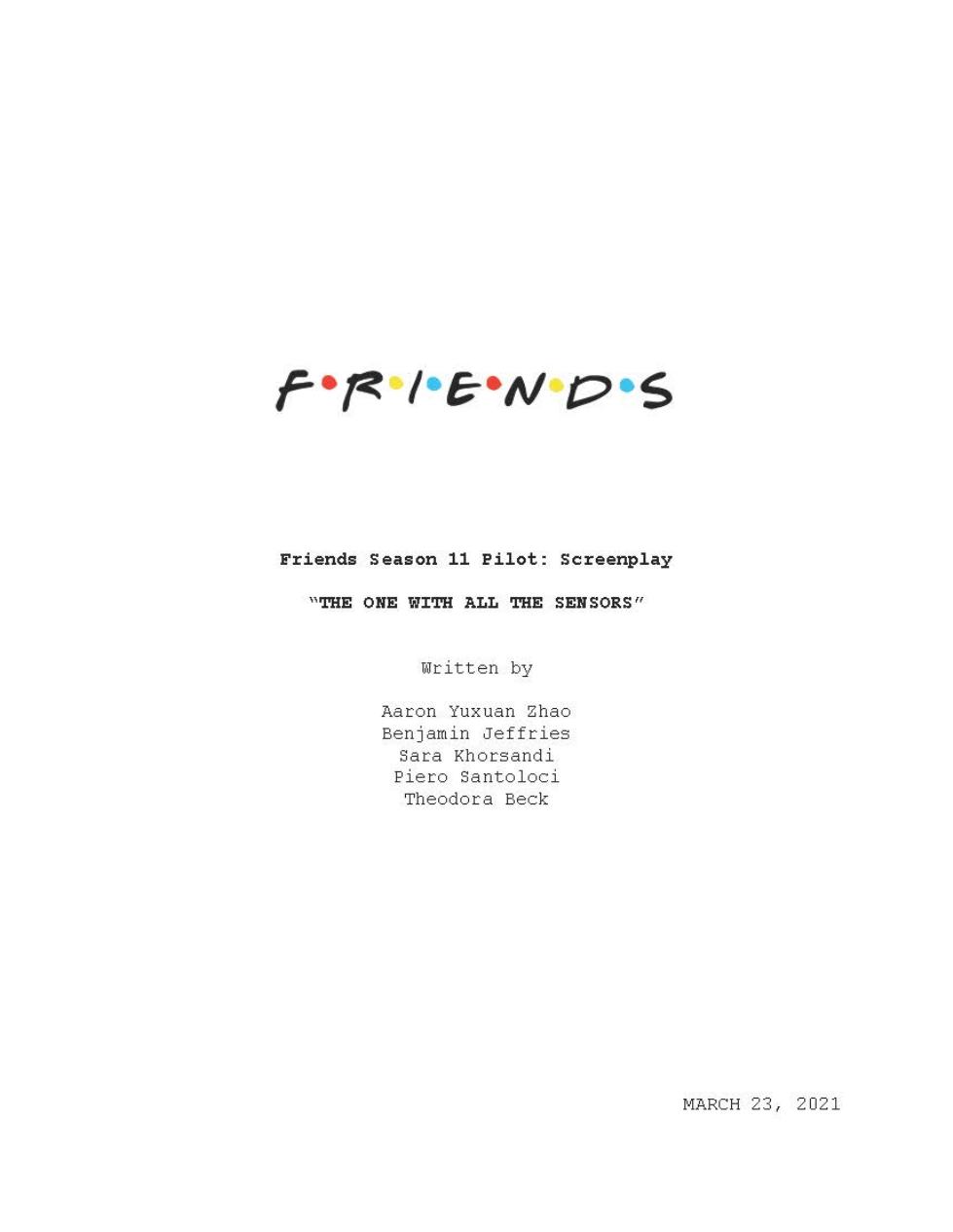
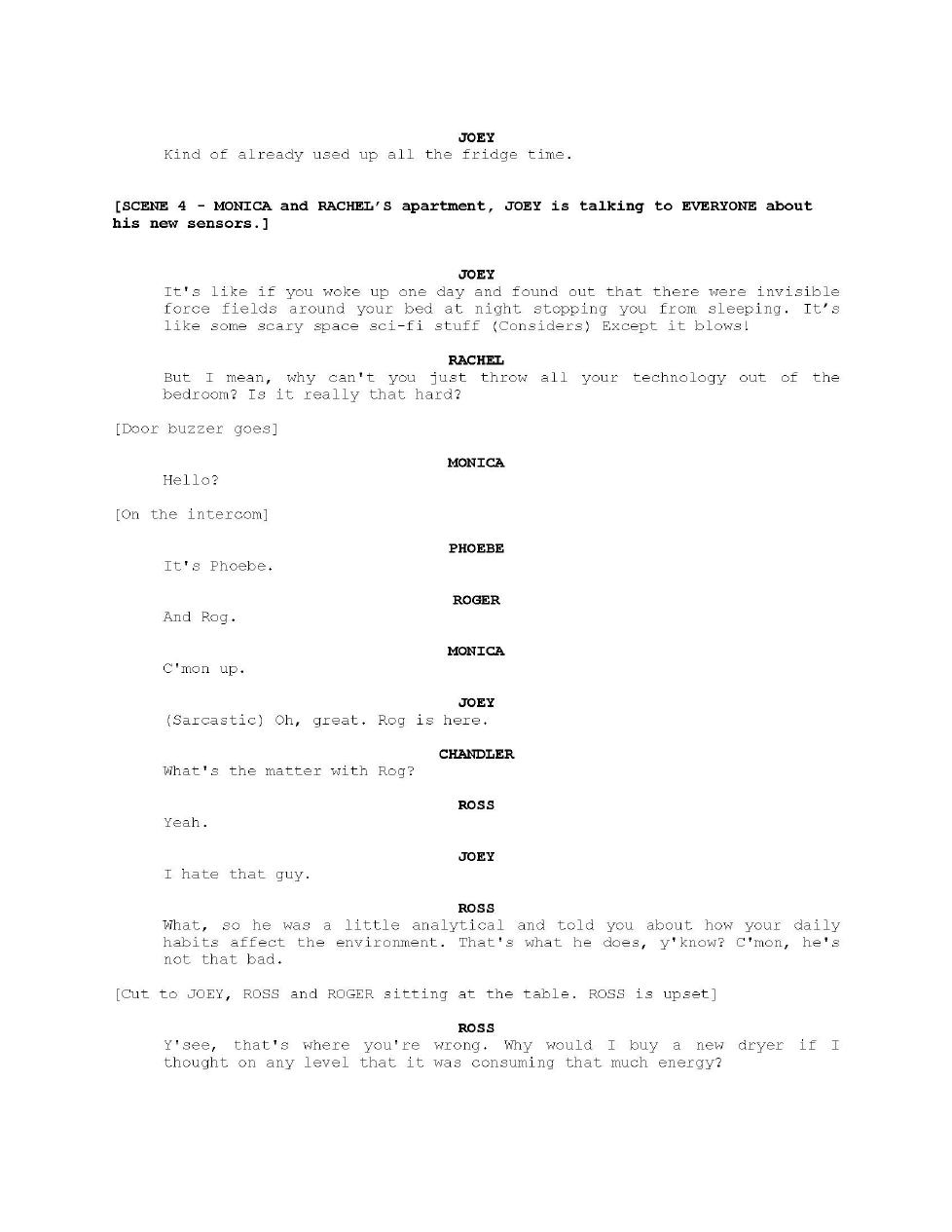
Pilot Episode Script - “The One With All The Sensors”

  • Screenplay title page - Friends Season 11 Pilot, ‘The One With All The Sensors’.
  • Pilot screenplay, page 2.
  • Pilot screenplay, page 3.
  • Pilot screenplay, page 4.
  • Pilot screenplay, page 5.
  • Pilot screenplay, page 6.
  • Pilot screenplay, page 7.
  • Pilot screenplay, page 8.
  • Pilot screenplay, page 9.
  • Pilot screenplay, page 10.
  • Pilot screenplay, page 11.
  • Pilot screenplay, page 12.
  • Pilot screenplay, page 13.
  • Pilot screenplay, page 14.
  • Pilot screenplay, page 15.
  • Pilot screenplay, page 16.
  • Pilot screenplay, page 17.
  • Pilot screenplay, page 18.
  • Pilot screenplay, page 19.
  • Pilot screenplay, page 20.
  • Pilot screenplay, page 21.
  • Pilot screenplay, page 22.
  • Pilot screenplay, page 23.
  • Pilot screenplay, page 24.

Storyboard & Prop List - the pilot boards and speculative device catalogue

  • Storyboard and prop list, cover - Friends, provisional prop list, Season 11.
  • Storyboard and prop list, page 2.
  • Storyboard section divider.
  • Storyboard scenes 1 to 4 - the group reacts to a climate news report.
  • Storyboard scenes 5 to 8 of the pilot episode.
  • Storyboard scenes 9 to 14 - the characters compete over their new sensors.
  • Prop list section divider.
  • Huggy Radar - a stuffed penguin housing an electro-magnetic field sensor that vibrates when readings run high.
  • The Good News Bot - a ceramic cone speaker that counters negative climate headlines with positive news.
  • (No)Dull House - a cardboard doll’s house that lights its rooms to warn of poor air quality.
  • Food Expiration Sensor - a pickle jar with a framed screen that reads food entering the fridge and flags expiry dates.
  • The Interrupter - a ceramic polygon speaker that breaks into dinner conversations with climate advice.
  • Energy Ball - a soft football that stores the energy generated by throwing it around.
  • Fridge Locker - a device that detects how long the fridge door is left open and locks it shut.
  • Claim Compass - a rose under a glass dome that changes colour in response to the home’s air quality.
  • Climate Conscious Chair - a leather armchair that forces you upright once household TV energy use hits its quota.
  • Floor Vibration Sensor - a floor unit that harvests energy from footsteps and movement around the home.
  • Storyboard and prop list, back cover - Season 11, March 2021.

The Work

Created a speculative Season 11 of Friends as a narrative framework for exploring environmental sensing technologies.

Designed a collection of speculative domestic sensing devices that examined the relationship between people, data, and the home.

Wrote the pilot episode script, integrating environmental technologies into everyday scenarios.

Produced a storyboard, concept artwork, and physical props to visualise the speculative world.

Directed and produced a video trailer and live table-read performance to communicate the project.

Designed a companion workbook extending the speculative products, scenarios, and research beyond the pilot episode.
Impact

  • Reframing Environmental Sensing

    The project explored environmental sensing through storytelling rather than technical explanation, using design fiction to make complex technologies more approachable and engaging.

  • Demonstrating Narrative as a Design Tool

    By combining speculative products, scripts, physical props, and film, the project showed how narrative can be used to communicate research, explore future scenarios, and test ideas that are difficult to prototype conventionally.

  • Bridging Research and Design

    The project combined environmental research, speculative product design, storytelling, and visual communication into a single body of work. It demonstrated how design can be used to explore complex societal questions through tangible concepts rather than written research alone.

Selected Works

View all